

Stay up to date with our data, and download the (free) chart pack below.
Updated every month.

The Blindingly Obvious Way to Diversify Canada’s Exports: Pipelines
The national conversation about diversifying Canada’s exports away from the U.S. has produced no shortage of proposals. The latest is deeper ties with Europe. However, this misses the most obvious opportunity sitting right beneath our feet. Building more pipelines to tidewater would let Canada sell crude at world prices to buyers in Asia.

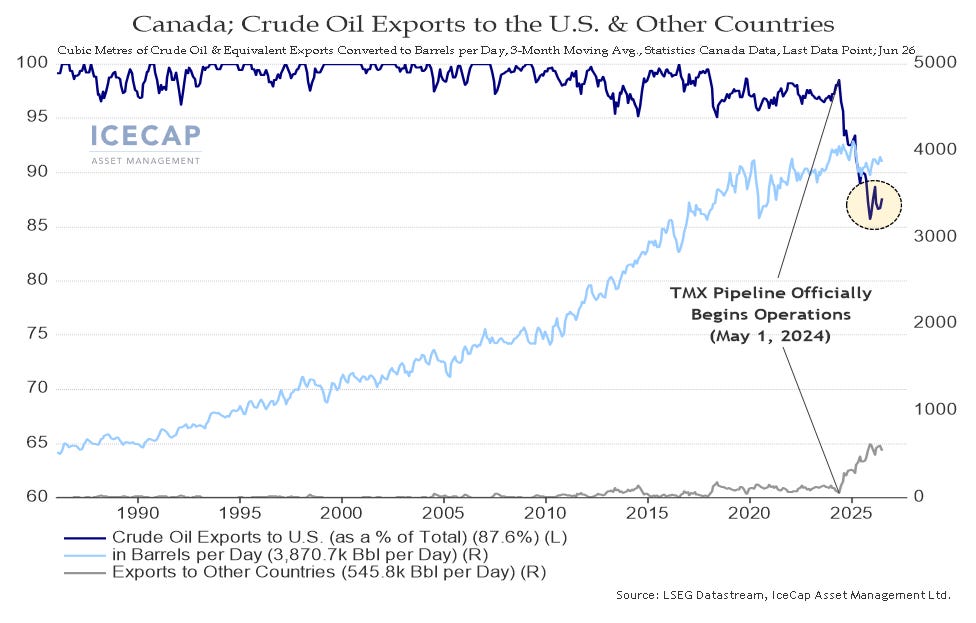
Canada is the world's fourth-largest oil producer. Energy dominates our export mix, and most of it flows south by pipeline to American refineries at a discount. This is because the oil is trapped due to insufficient egress.
The completion of the TMX pipeline highlights how effective pipelines can be. Before May of 2024, nearly every drop went south to America. Since then, crude oil exports to other countries have soared!
Uncertainty Over the Trade War Hits Services Sentiment
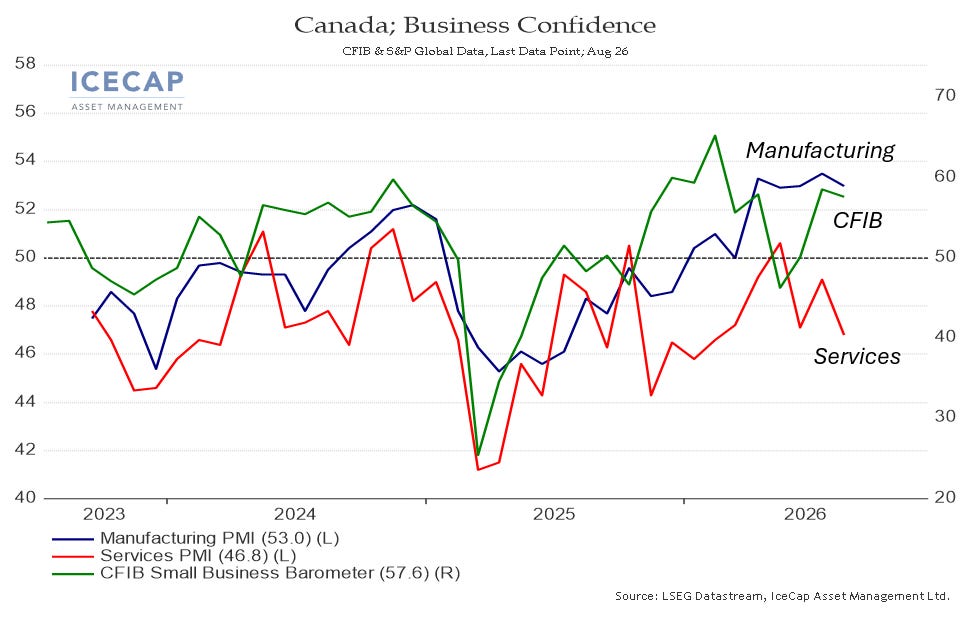
Canada’s Services Sector PMI contracted for a third consecutive month in August. At 46.8, it is the lowest reading since February. Note that any number below 50 signals contraction. The drivers are familiar: escalating trade tensions with the U.S., ongoing conflict in the Middle East, rising energy prices, and higher wage and operating costs.
It also confirms what Governor Macklem noted in his most recent press conference. Businesses have learned to navigate higher tariffs. They have worked with suppliers and found new markets. What is far more difficult to navigate is uncertainty. Uncertainty, not the tariffs themselves, freezes hiring, defers investment, and poisons business confidence. On that measure, August’s survey offered little reassurance.

Meanwhile, the Manufacturing PMI held firm as many manufacturers benefited from higher fuel and mineral prices, along with lagged effects from orders delayed earlier in the year that are now being fulfilled. Critically, however, the latest survey was mostly conducted before the recent collapse of trade negotiations with the U.S.; we may have already seen a high-water mark.
Canada Is No Longer in a “Technical Recession”
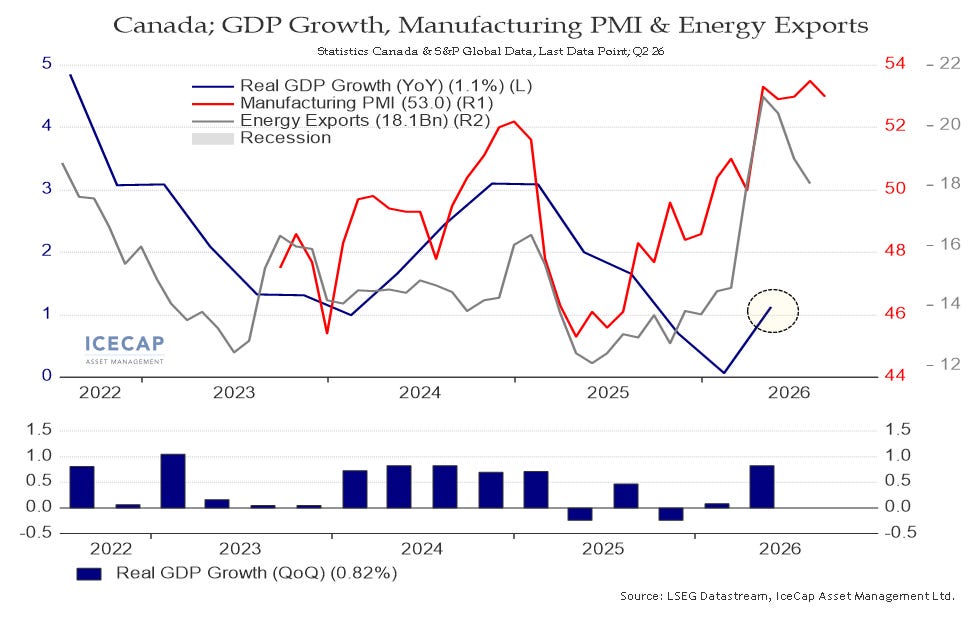
GDP data is by definition backward-looking. It is also imperfect and hence almost always revised. This is especially true when key inputs, for example, in Canada’s case, the exports of oil and gold are highly volatile. That is exactly what happened to Canada’s Q1 GDP number, which moved from slightly negative to slightly positive, negating a technical recession - or two quarters of negative growth.
This happened because Canada’s energy exports soared. The war in Iran has constricted the output from a key oil-producing region. This has sent crude oil prices to the moon and, to the surprise of only people, mainly in Ottawa, who have fought to keep oil in the ground, these higher prices have translated into billions of extra dollars for Canada in taxes and royalties and helped improve growth. Higher gold prices had the same effect. Fate loves irony. Canadians are profiting from it.
Take a look at the data yourself with the downloadable Chartpack below.
The Loonie Hour Investor Series:
Also, if you are in the Ottawa area and want to learn more about Canadian housing, navigating the global economy, markets, and investment strategies to protect and grow your wealth, please join us at The Loonie Hour Investor Series. Tickets are now Live!
We can expect another million bbl/d just from brownfields projects ongoing to take up all the remaining pipeline capacity. That oil, at least, is not trapped by anything but a few years of time to complete the straightforward projects:
https://www.oilsandsmagazine.com/news/2025/11/11/another-quantum-leap-cnrl-unveils-over-15b-in-oil-sands-expansions
...the $15B in brownfields oilsands investments go along with ~$5B in pipeline-capacity-expansion projects, and we don't actually stop growing the sales until about 2030.
https://www.oilsandsmagazine.com/market-insights/2025/12/11/pipeline-egress-outlook-to-2030-2026-edition
We, of course, could be planning now for new infrastructure around 2030, but that will take some big investments. I'm not aware of estimates for new greenfields oilsands projects that will cost less than $30B for another million bbl/day. (Kearl Lake in 2013 produced only 900,000 for over $20B, no?)
For transmission, it's a billion for a diluent pipeline from Edmonton, a billion for the dilbit pipeline back, and, again, I'm not aware of an estimate under $30B for a pipeline from Edmonton to any tidewater. (Which is funny, because it's a belief that the TMX would really have only cost $4.5B if it weren't for the darn government opposing them every step of the way...or something. Maybe it really would always have been $34B, no matter what? Guesses?)
Needless to say, you can only hit every barrel of oil with as little as $10 (that's based on 5% interest in $70B) if you can expect steady sales for 25 years. And good interest rates.
Is the international business and investment community confident in those 25 years of sales for over $50/bbl? If not, it may explain why nobody has stepped forward with such a project.
Thanks for this. The TMX chart stuck with me most. Seeing exports to other countries climb after May 2024, after decades of nearly everything going south, shows how much of our "dependence" on the U.S. came from a lack of options rather than a lack of demand elsewhere.
I also appreciated the point that uncertainty does more damage than the tariffs themselves. Businesses can price in a known cost, but they can't plan around a moving target. That would explain why services are sliding while manufacturing holds up.