


In April, Keith warned that a prolonged conflict between the U.S., Israel, and Iran would drive food prices higher by raising the cost of the inputs that industrial agriculture depends on. For example, natural gas the primary feedstock for fertilizer. Unfortunately, it is playing out exactly as he suggested.
The systems that produce and deliver food are global. Hence, a major shock in one part of that system, especially in a region closely tied to energy, will eventually show up in costs halfway around the world.
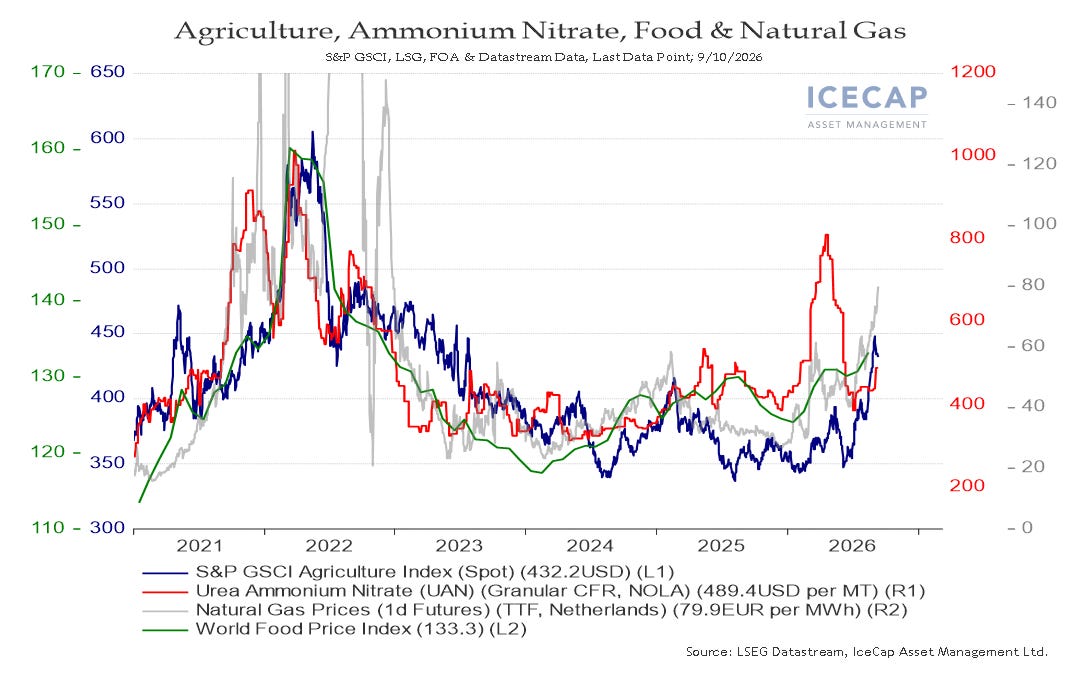
To be fair, we expected it to be far worse by now. Despite the rise in energy prices, the World Food Price Index is only up 7% year-to-date. The global economy has shown incredible resilience, and the energy shock has been absorbed to some degree by the actions of the global superpowers, the U.S. and China, which have depleted their oil reserves and stopped importing oil, respectively. This is why, even though 10% to 15% of global crude oil exports are sequestered in the Persian Gulf, crude oil prices are still only $100 a barrel — and even that has only just occurred.

However, things in economics and capital markets, as in life, are rarely linear. The global energy system, and diesel in particular, looks like it is finally cracking. Or, more germane, has already cracked. This is because, although countries can influence the price of crude oil for a time, think of OPEC as another example. It is nigh impossible to manage the price of distillates such as gasoline or diesel.
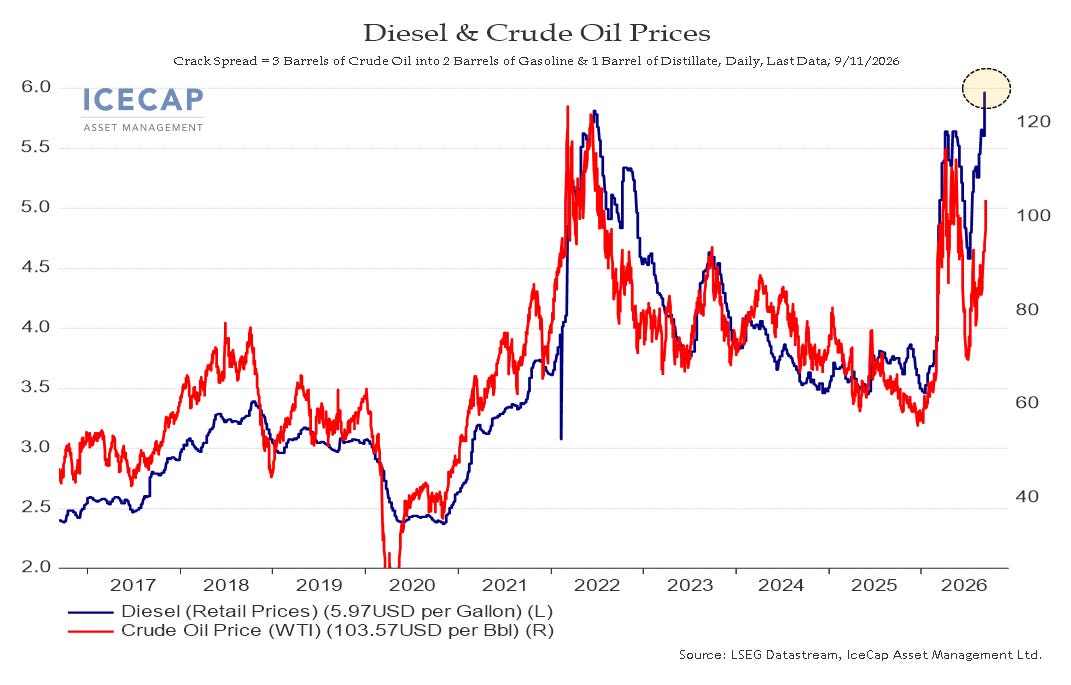
Unlike crude oil production, which OPEC can tighten or loosen through coordinated output decisions, refined products such as gasoline and diesel are a fundamentally different market. Hundreds of independently owned refineries across both producing and consuming countries make them — no single group controls global refining capacity the way OPEC+ controls crude production. Once a barrel of crude is sold, the refiner, not the producer, decides what comes out the other end. Refineries can shift their output between gasoline, diesel, jet fuel, and other products, but only within technical limits.

Those decisions are driven by crack spreads, the margin between product prices and crude, and not by instructions from oil-exporting governments.
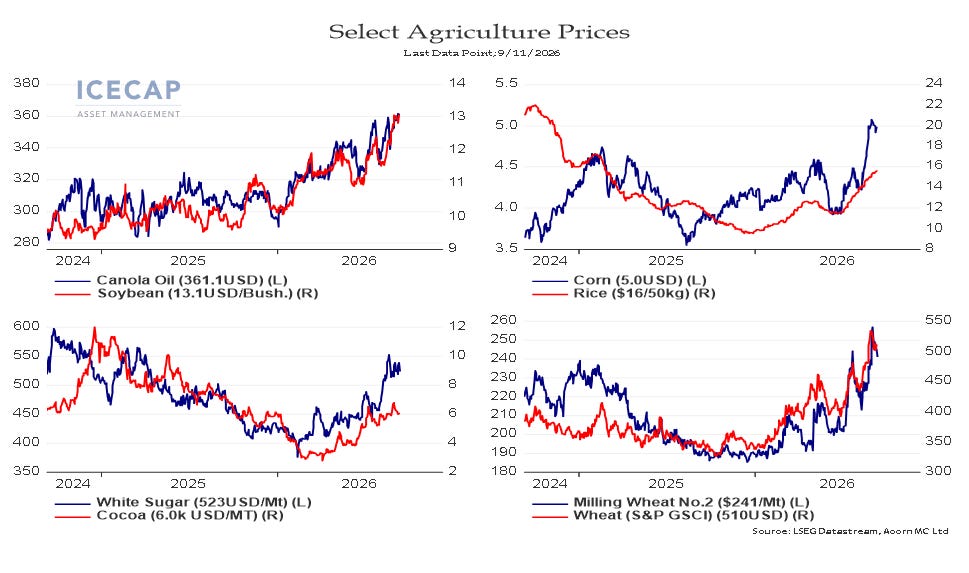
So why does that matter? Because modern agriculture relies not only on fossil fuel-based fertilizer, but also on fuel to get things done. Tractors, irrigation systems, food processing plants, and transportation networks all depend on gasoline and diesel. When fuel gets more expensive, everything tied to food production gets more expensive, too. That increase doesn’t stay at the farm level; it is passed along to consumers. But before those price changes hit the shelves, wholesalers feel it, and that’s exactly what is happening. The chart below highlights that foodstuffs across the board are rising.
In Canada, distance exacerbates this. While Canada may produce a lot of meats, grains and seed oils, fresh produce often comes from the United States, Mexico, and South America, travelling thousands of kilometres before reaching store shelves. Even domestically produced food must be transported long distances by rail or truck. As fuel costs rise, so does the cost of getting food to market.
All of this matters because of inflation, which is just a fancy way of saying changes in prices. It also matters because of how it will affect bond markets and, in particular, what central banks might do. Or be forced to do, and you can see that below.
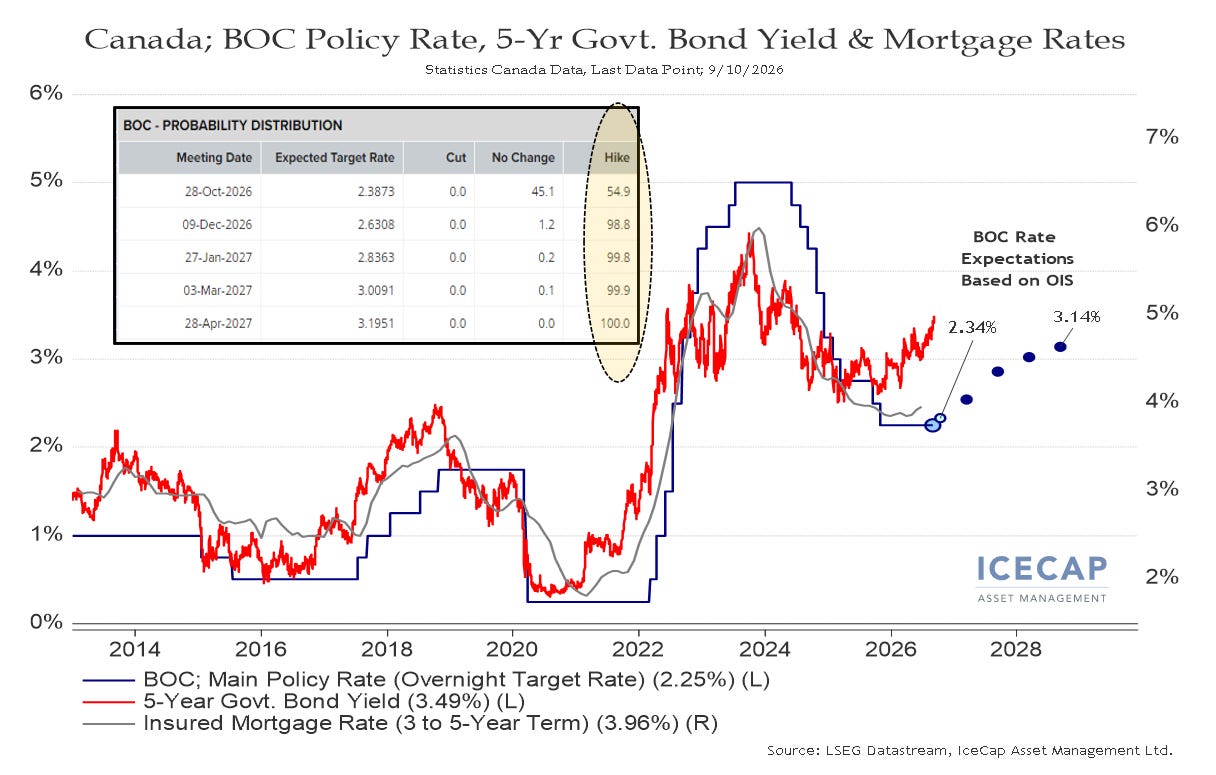
Rate hikes are already being priced in. The assumption is that rising food and energy prices will prompt central banks to tighten. But that would be a policy mistake. A central bank can cool an overheating economy by making borrowing more expensive. It cannot plant wheat, refine diesel, or reopen the Strait of Hormuz. Raising rates into a supply shock does not bring prices down — it simply slows the economy while prices keep rising. The result is the worst of both worlds: higher costs and weaker growth arriving at the same time.

Central banks will face an uncomfortable choice. Fight inflation they cannot control and risk tipping already fragile economies into recession — or hold, and accept that inflation runs hotter for longer. Neither is a good option. But one is considerably less damaging than the other. Canadians would do well to prepare for an extended period of elevated food prices regardless of what central banks decide — because the forces driving them are not responding to interest rate policy.
Stagflation came one step closer with the Houtie hit on the pipeline and the other strait. Although I think it only accellerated the process. As reserves deplete, refinery capacity is reduced, diesel shortages, fertiliser prices have already hit the planting season, helium prices hit all sorts of top end semiconductor manifacturing, it has been a very real scenario for some three months already.
Some central banks have already hiked rates despite imported inflation on necessities being the main driver. Trying to solve todays problems with yesterdays tools.
I am not impressed.
Crack spread