


Europe is in serious trouble. This two-part series starts with Germany and ends with France, its two largest economies. This is because without a strong core, the European project falls apart. Italy, Spain, and the rest lack both the political heft to turn things around and the balance sheet to backstop a crisis.
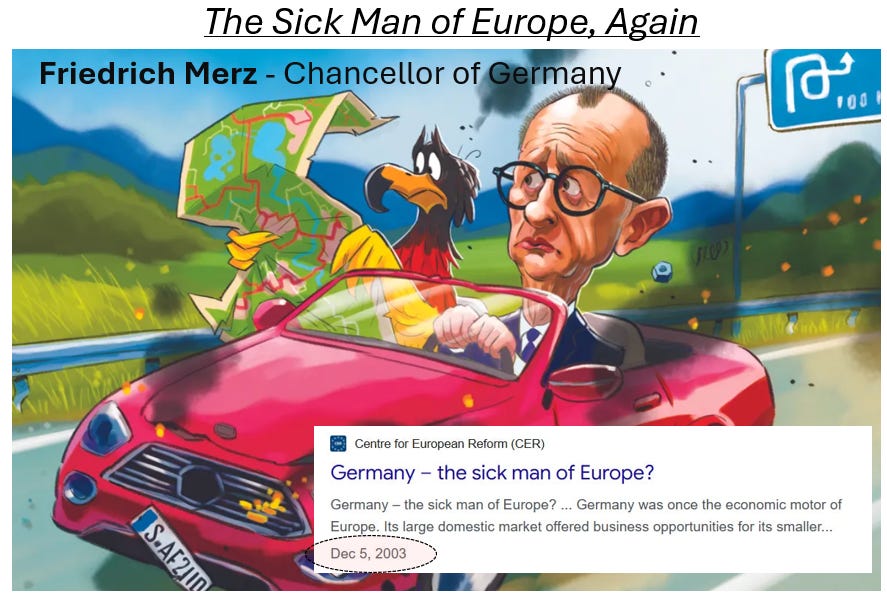
So, to Germany, where we have seen this movie before. Twenty-five years ago, Germany was known as the “Sick Man of Europe.” After the fall of the Iron Curtain came reunification, and while joyous, it was bloody expensive; that huge financial cost contributed to severe economic stagnation and stubbornly high unemployment. Forced to confront the malaise, the government introduced sweeping labour market and welfare reforms known as Agenda 2010. It worked. With help from a cheap euro, Germany transformed itself into the world’s foremost manufacturing powerhouse, exporting fast cars, slick engineering, and dour underground techno worldwide.
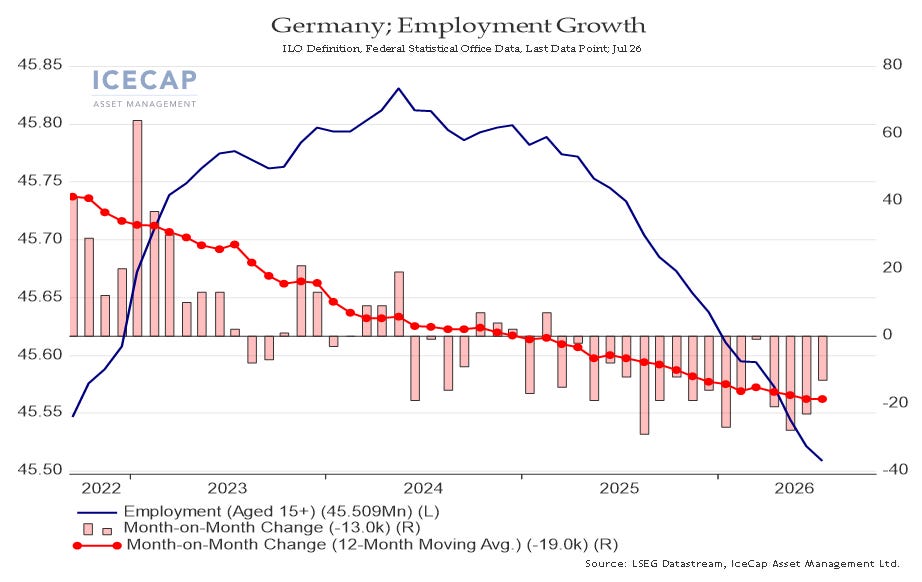
Fast forward, and Germany is again sick. It now faces a dual threat: an energy shock and fierce competition from fellow industrial giant and emergent global superpower, China. Neither is going away, and it is stark. Germany is hemorrhaging jobs. Total employment has shrunk for seventeen consecutive months, and it looks even worse if you exclude the growing public-sector employment.
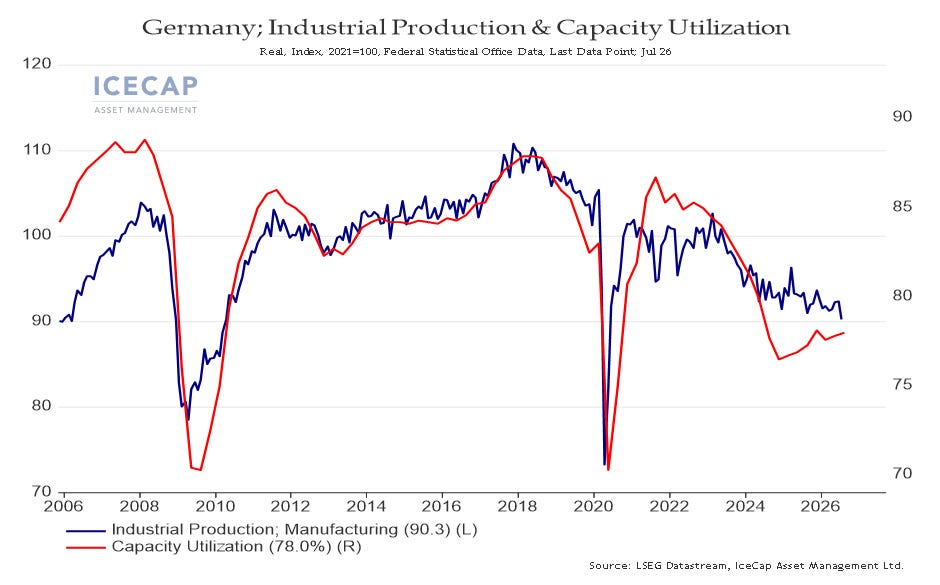
It is particularly jarring when one considers the collapse in industrial production, down roughly 20% from its 2019 peak, and capital utilization. Anecdotally, it is also likely to get worse, and this will no doubt continue to batter the German ego as announcements out of the auto sector come fast and furious. Germany’s biggest carmaker, Volkswagen, is set to close four German factories, with production relocating to Poland, Slovakia, and the Czech Republic. Mercedes-Benz has shifted van production from Berlin to Jawor, Poland — where labour costs are nearly five times lower, and BMW has opened a new plant in Debrecen, Hungary, while Audi is breaking production records in Győr.
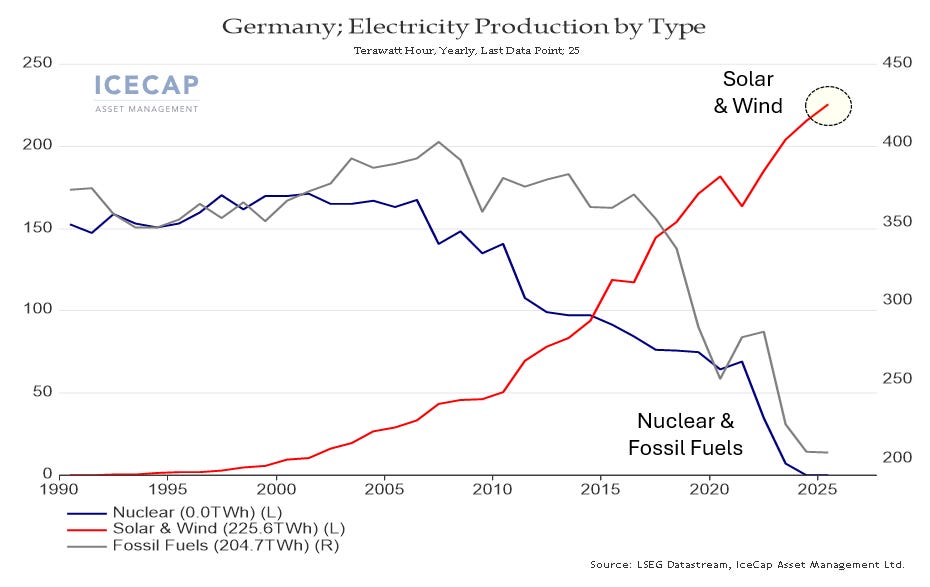
These are not temporary adjustments. They are permanent relocations by companies that have concluded that Germany’s cost structure is no longer compatible with such a competitive global market. The proximate cause was the spike in natural gas prices following Russia’s invasion of Ukraine in early 2022. Much higher energy input prices made manufacturing a car in Germany dramatically more expensive almost overnight. Critically, it also exposed the fragility of a naive industrial policy built on cheap Russian gas and renewable energy.
It cannot be overstated that the energy shock Germany, and the rest of Europe, faces has been exacerbated by ‘Green’ energy policy. By far, the most reckless was presided over by a trained physicist, former Chancellor Angela Merkel. Regardless of the perceived ‘safety’ risks, it was insane. Germany’s nuclear power industry had an excellent safety record and might have been the envy of the world: 23 gigawatts of domestic, clean, stable power. From an industrial perspective, wind and solar are by definition intermittent and were always unfit for purpose. In short, Germany was vulnerable to an energy shock because it traded affordability, reliability, and energy security for warm, fuzzy feelings. This was catastrophic.
Enter China. Long gone are the days of cheap trinkets and low-value manufacturing. Chinese companies have spent decades climbing the global value chain and now dominate several key industries, producing excellent products the world depends on. The automotive sector was once the exception. Electric vehicles ended that.
It’s obviously complicated, but in short, German automakers were told that to sell cars in China, they had to share proprietary processes and patents. That was, ultimately, the beginning of the end.
Meanwhile, China’s massive crude oil imports are a major source of strategic vulnerability. This made any path away from internal combustion engines attractive. EVs offered a way to reinvigorate an economy wobbling from a real estate bust while reducing dependence on a commodity bought from a volatile global market. The fit was perfect. China is now the world’s largest car exporter.
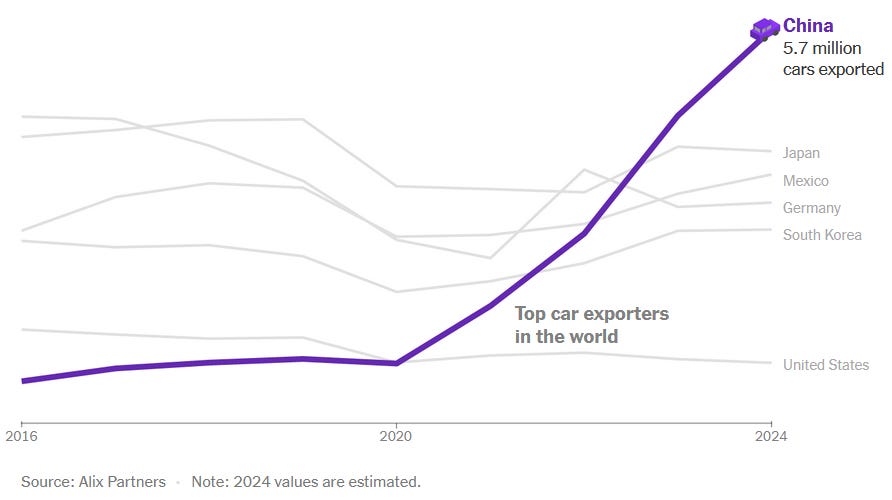
But it wasn’t just EVs. Across a spectrum of sophisticated industrial engineering, China is outcompeting Germany. More power to them. The upshot for Germany is straightforward: exports are no longer growing, and the industries that built the German miracle are under sustained, structural pressure that no short-term policy fix is likely to reverse.
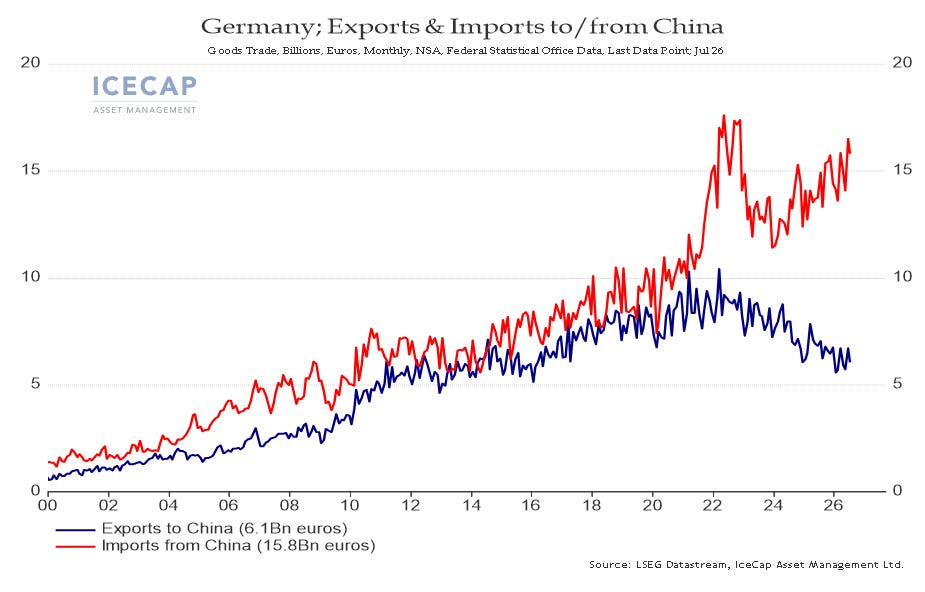
All this matters for two reasons.
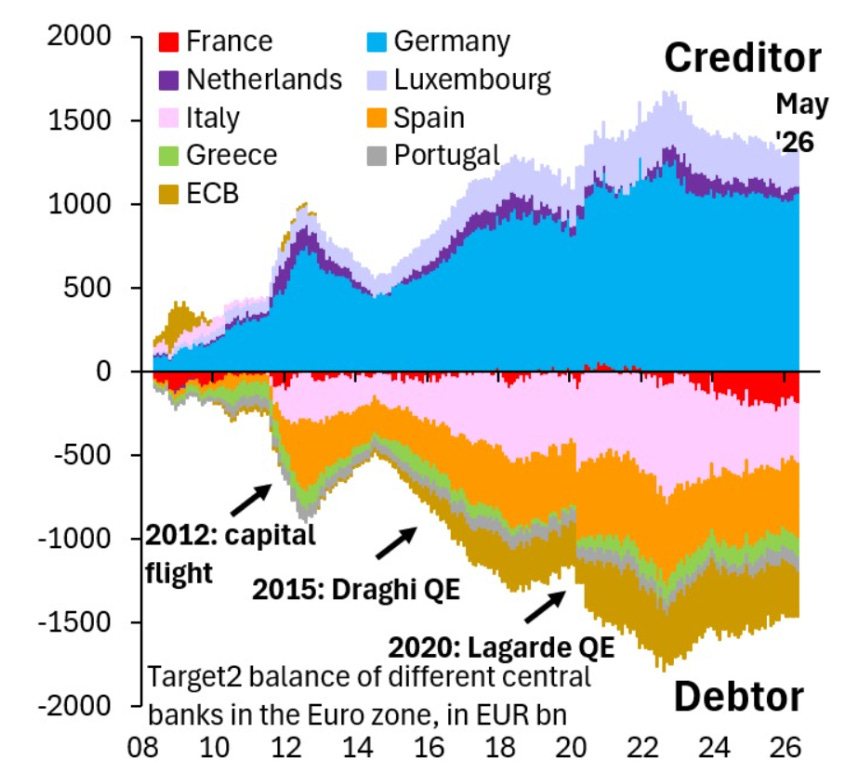
One, Germany is Europe’s economic backbone (~25% of E.U. GDP). It is still by some distance the union’s largest economy, and its industrial base has, for decades, done the heavy lifting that kept the broader European project solvent. But Germany isn’t just Europe’s biggest economy — it is also the backbone of Europe’s banking and financial system, effectively functioning as the Eurozone’s lender of last resort.
The clearest evidence is Germany’s TARGET2 balance — the running tally, calculated by the European Central Bank, of what each national central bank in the Eurozone owes or is owed within the currency union’s internal payment system. In plain terms: the rest of the currency union owes Germany, collectively, more than a trillion euros. Germany is Europe’s creditor. Without Germany producing and paying for Europe, the economic schisms there will grow, and volatility in credit markets will increase.
Two, Germany's politics is shifting right, and not gently. Berlin’s governing parties, the CDU & SPD, have spent years unable, or unwilling, to seriously confront two things: the economic malaise laid out above and growing concerns over mass immigration and integration. This is coming to a head. Voters have noticed, and they are punishing the parties that have governed through it.
The beneficiary is Alternative for Germany (AfD) — explicitly anti-EU, hard-line on immigration and asylum, and, by some measures, now the country’s most popular party. This isn’t just opinion polls; the AfD just won two federal bellwether state elections. As a result, Chancellor Merz called it a ‘disaster’.

For now, Germany’s mainstream parties maintain a so-called “firewall,” refusing to govern with the AfD regardless of its vote share. But a firewall built on deeply unpopular parties is not a solution. The sad truth is that Germany’s political centre cannot or will not address the immigration and economic anxieties driving voters toward the AfD. Either way, after a few more state elections, the Germany that emerges will look very different from the one that has anchored Europe for the past seventy years.
Germany’s troubles are not an isolated story. In Part Two of this series, we turn to France — Europe’s other core economy, facing a strikingly similar set of political pressures but with a much heavier debt load, less industrial heft, and a bloated state that will make changes nigh impossible to implement. If the Eurozone’s foundation rests on its two largest economies, it doesn't look good.
~rd
Great piece Rich !
You guys have done a good job monitoring Germanys collapse after they abandoned nuclear, i always thought their decision ( which happened right after the earth quake in Japan that nearly caused a meltdown) was based on fear and political gain , there was no benefit to anyone but the political people on power at the time. They are starting to reap the reward for that mistake.
Doug Ford may be far from perfect but at least here in Ontario we've embraced the nuclear....for now.