


In Part One of this two-part series, we laid out why Germany’s economic malaise means trouble for Europe writ large. Its economy is pincered between an energy shock and stiff competition from China, an emergent auto-export powerhouse. In Part Two, we turn to France — Europe’s other core economy.

France is smaller but often takes center stage in the European Union. This is a legacy of WW2, and perhaps the lingering intergenerational guilt in Germany. Size also matters; France’s economy is the world's 7th largest, about 65% of Germany's. The two account for roughly 40% of the E.U.’s GDP.
If Germany is Europe's factory floor, France helps anchor the bloc through services, luxury, tourism and aerospace exports, and state-backed energy and infrastructure. Add genuine military might and a strong diplomatic core, and Paris can drive the EU's political and strategic agenda.
However, something is rotten in the City of Light. France faces a similar set of political pressures, but carries a much heavier debt load and a bloated state that makes meaningful reform nigh impossible… without a crisis.
In France: l’économie, c’est l’état1. The state is the economy. Three and a half centuries after Louis XIV's rumoured quip, “Public spending has been rising for 25 years, now at 57% of GDP, 8 percentage points above the European average, epitomized by the bloated number of public employees, up by 1m since 1997. Over this period, public sector staff numbers have risen 23% alongside a population rise of 15%.” This inability to control government largesse is reflected in a budget that hasn’t been balanced since 1980.
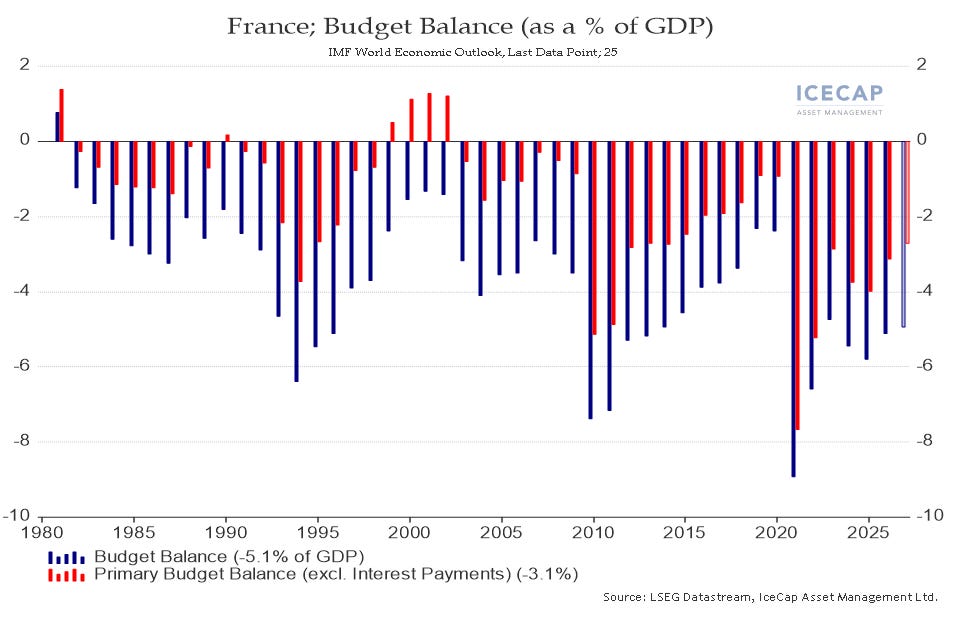
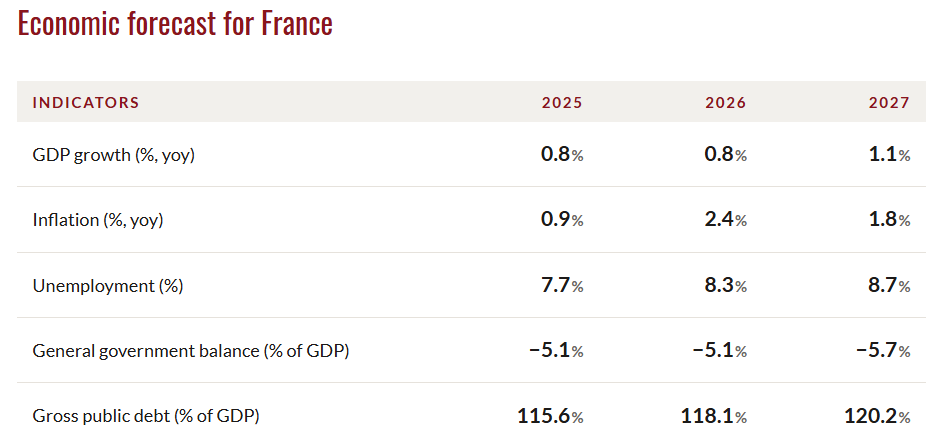
These figures are set to get worse. France’s budget deficit sits at 5.1% of GDP, nearly double the Maastricht Treaty’s supposed 3% ceiling. France itself insisted on this arbitrary ceiling when the euro was designed, and breached it in all but a handful of years that followed. The decades of overspending, paired with weak growth, have driven general government debt to roughly 120% of GDP. This is nearly top of the table. Unfortunately, this also comes at a time when France’s tax burden, at 45.3% of GDP, is already among the highest in the developed world. There is no more wine to squeeze from this grape.
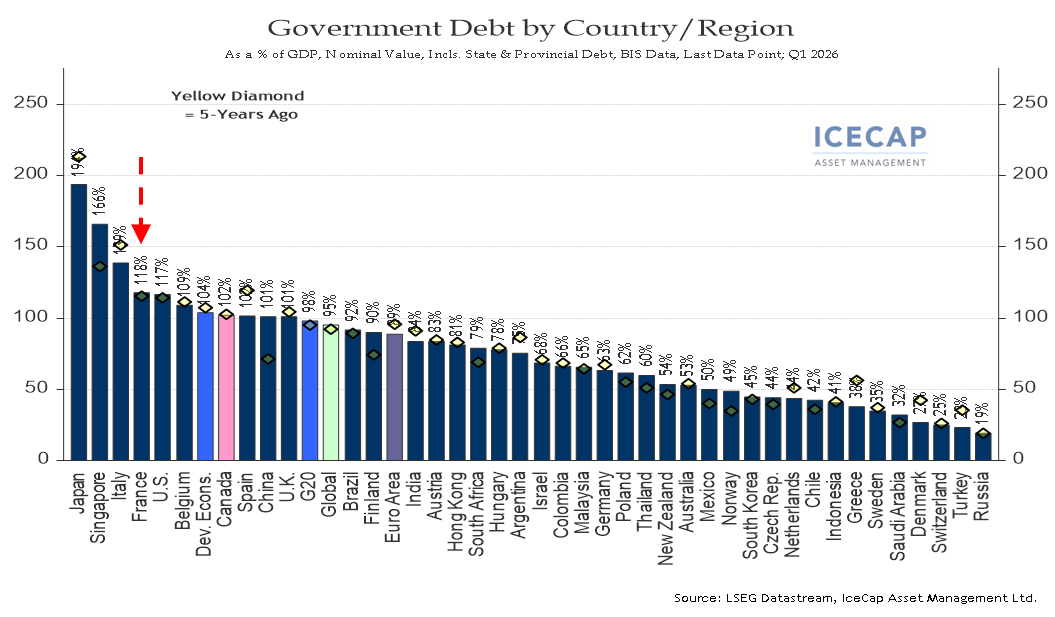
In a way, none of this is new. What is new is that global bond yields are rising. This changes things because for 40 years, government bond yields were falling. That meant successive French deficits and debt could be refinanced at ever lower rates. That old world is dead. Bond yields are rising, and so, by definition, is the cost of refinancing that debt pile.
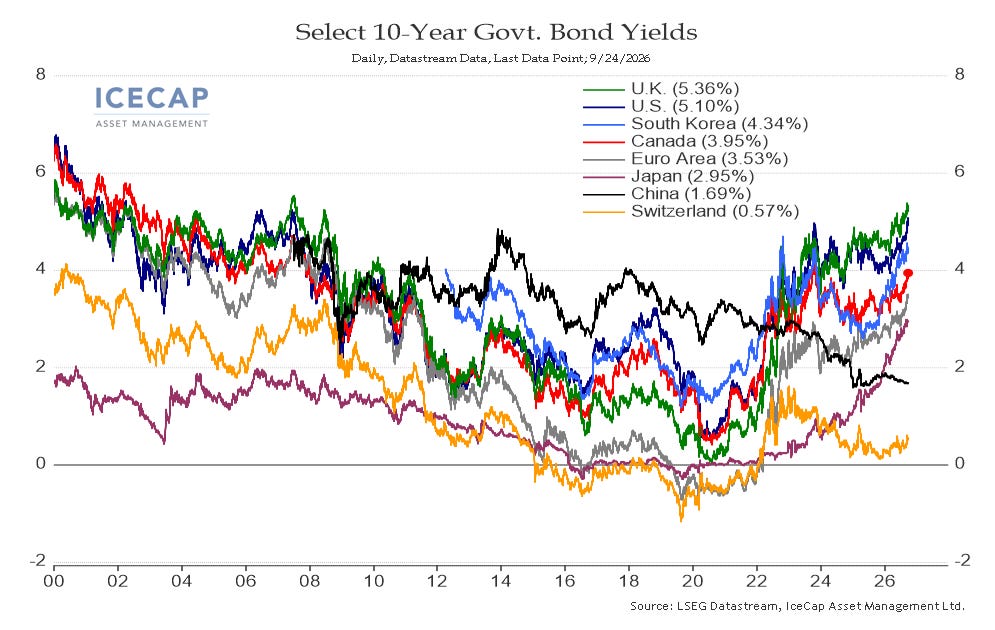
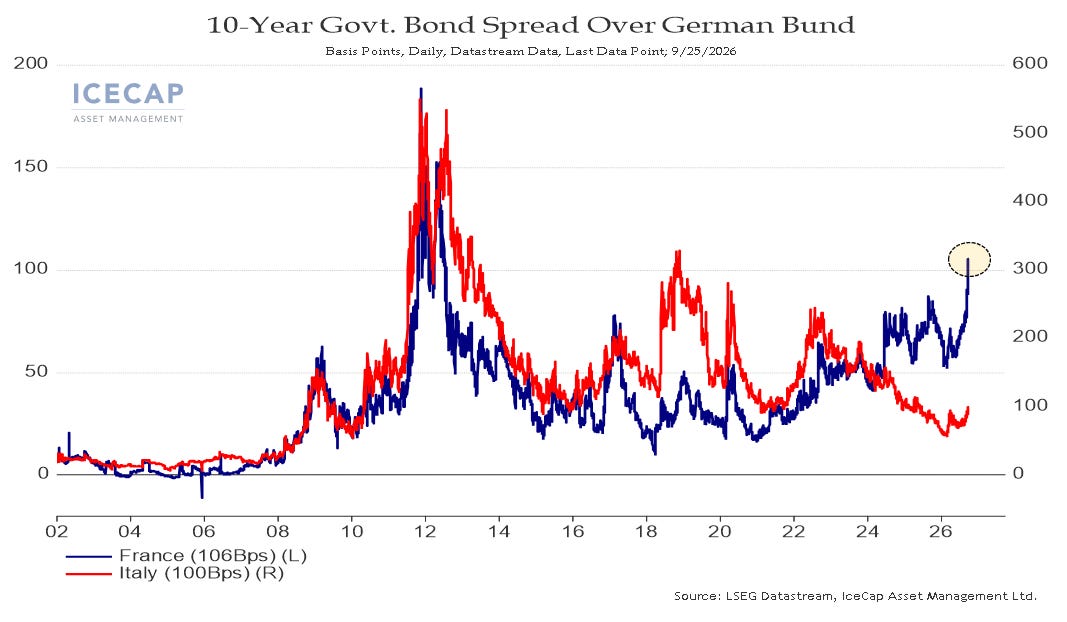
Since July 2026, its 10-year bond yield has pushed above 4%, and interest payments on the national debt have more than doubled since 2020, from €29.7 billion to €65.7 billion. This sum is large enough to crowd out real spending decisions and further weigh on a dim economic outlook. The bond market has noticed and pushed up the spread (the market’s risk premium) between French and German 10-year bonds to a 15-year high! Much higher, and it will suggest a crisis is brewing.
What about that growth, or the lack of it? French GDP grew by 0.8% in 2025, and forecasts call for much the same, or worse, this year. Real GDP per capita has grown at barely 59% of the OECD average over the past 25 years. Unemployment has not fallen below 7% since the 1970s and sat at 8.3% in the second quarter of 2026. Industry's share of the economy has collapsed from a quarter of GDP in the 1970s to just over a tenth today, despite two decades of "reindustrialization" policy. Meanwhile, France's own engineers and young professionals are leaving for better jobs abroad and lower taxes. This is tantamount to a state-funded brain drain, as France subsidizes education by roughly €1 billion a year.
The difficulty is that governments have known the fix for years (i.e., spend less, tax production less, and reform the labour market) but have declined to do it because it is too politically costly. French civil disobedience is legendary and so is their penchant for rioting. Further complicating things are the growing social frictions around immigration and integration. This is a sensitive subject that we’ll dodge here, but poor economic outcomes clearly exacerbate it.
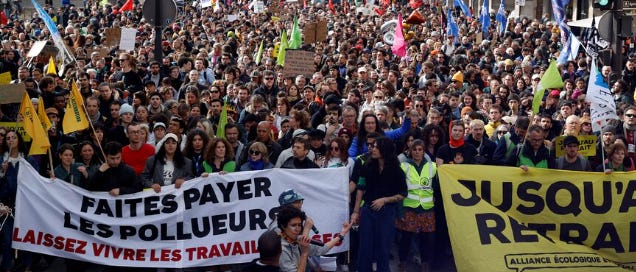
En tout cas, le peuple n’est pas content!
In any event, the people are not happy, and they are reacting much as German voters have, by turning to the anti-establishment, anti-E.U., party promising to fix things long broken. This may be a story as old as time, but the momentum is real. Marine Le Pen's National Rally now leads the field for next year's presidential election by a decent margin, and Le Pen's legal trouble may not matter. Her party, just like the AfD in Germany, is not going away.
![May be a graphic of text that says "EUROPE FL FLECTS France (Presidential run-off election) Elabe poll for BFM TV and La Tribune Dimanche 26-28 August 2026 2022 electian Polling result 1,501 respondents 52.5% 57% 47.5% Next election: 2 May 2027 42% 69.5% 57% 42% 43% 42% 43% 42% 30.5% Le Pen RN AN(PIE) PIE) Philippe HOR (RE) Le Pen Altal Le Pen (PFE) RE(RE) N(PE) ECR: national-conservative EPP: centre-right ESN: far-right NI: mixed PIE: right-wing RE: liberal Glucksmann PS/PP (SED] Le Pen S&D: centre-left AN [PE) *:unaffiliated Melenchon LF1(LEFT]"](https://substackcdn.com/image/fetch/$s_!gZI5!,f_auto,q_auto:good,fl_progressive:steep/https%3A%2F%2Fsubstack-post-media.s3.amazonaws.com%2Fpublic%2Fimages%2Fd48c5180-2926-4440-b27d-0ad173d62bdb_960x538.jpeg "May be a graphic of text that says \"EUROPE FL FLECTS France (Presidential run-off election) Elabe poll for BFM TV and La Tribune Dimanche 26-28 August 2026 2022 electian Polling result 1,501 respondents 52.5% 57% 47.5% Next election: 2 May 2027 42% 69.5% 57% 42% 43% 42% 43% 42% 30.5% Le Pen RN AN(PIE) PIE) Philippe HOR (RE) Le Pen Altal Le Pen (PFE) RE(RE) N(PE) ECR: national-conservative EPP: centre-right ESN: far-right NI: mixed PIE: right-wing RE: liberal Glucksmann PS/PP (SED] Le Pen S&D: centre-left AN [PE) *:unaffiliated Melenchon LF1(LEFT]\"")
The upshot of this two-part series is that Europe and, by extension, the E.U. are in trouble. In short, decades of poor economic policy and a lack of political courage have left Europe's two major economies weak and, in a way, paralyzed. They are led by an establishment unwilling to confront its own mistakes and desperate to hold on to power. This is pushing the electorate to the extremes and thus putting the future of the European Union as we know it at risk.
At the same time, it is the beginning of the end of the 40-year interest-rate cycle. With record debt levels and anemic growth, the spectre of higher interest rates looms. Add political uncertainty, and it's a dangerous combination that may well lead to a sovereign debt crisis.
So why does all this matter for Canadians? Well, for one, the risk of contagion is real. Global capital markets are interconnected. A sovereign debt crisis in Europe will absolutely affect Canadian government bond yields, mortgage rates, and the equity market. This growing risk in Europe also calls into question the wisdom of a much tighter political union. But we digress. The reality is that without a strong core, the European project does not just wobble. It breaks. Right now, both pillars are cracking at once.
~rd
This is a callback to Louis XIV, who is apocryphally said to have bragged, “L’état, c’est moi”—I am the state.
I just finished reading the two part series; thanks Richard, it was great! As somebody that is from Europe (The Netherlands but is a Canadian resident for the last 10 years) and has been a Euro-sceptic since the start, I really hope Canada will use its common sense and won't tie its future to the museum of the world! Keep up the great work; been listening to the Loonie hour since episode 1; cheers!
I can’t believe Carney wants us to join this dysfunctional group! Now, do Canada! Excellent 2 part article, Rich. Thanks!