

I’ve argued before that there’s a good chance that housing in Ontario is entering what may be a multi-year bottoming process. Sales have stabilized in a number of markets, inventory is declining, and prices are no longer falling at the pace they were.
But there is an important distinction between the housing market bottoming and the credit cycle bottoming. They are not the same thing, and the latest data suggest Ontario’s credit hangover is still getting worse.
Think of it as the morning after a three-year real-estate kegger. The music has stopped, someone has found the Advil, but there are still people asleep in the bathtub.
This is a guest post from the fourth amigo Ben Rabidoux.
His weekly memo: www.edgeanalytics.ca
Bank mortgage delinquencies are still grinding higher
Start with the big banks. Gross impaired Canadian residential mortgage loans rose sharply again from a year ago at National Bank (+47.2%), BMO (+46.9%) and RBC (+41.3%). The geographic problem areas remain familiar: southern Ontario — particularly the GTA and surrounding regions — and the Lower Mainland in British Columbia.
The GTA numbers are particularly striking. CIBC reported a 0.66% delinquency rate in its uninsured GTA mortgage portfolio in Q3, while RBC was at 0.63%. Both are now more than ten times their post-COVID lows.
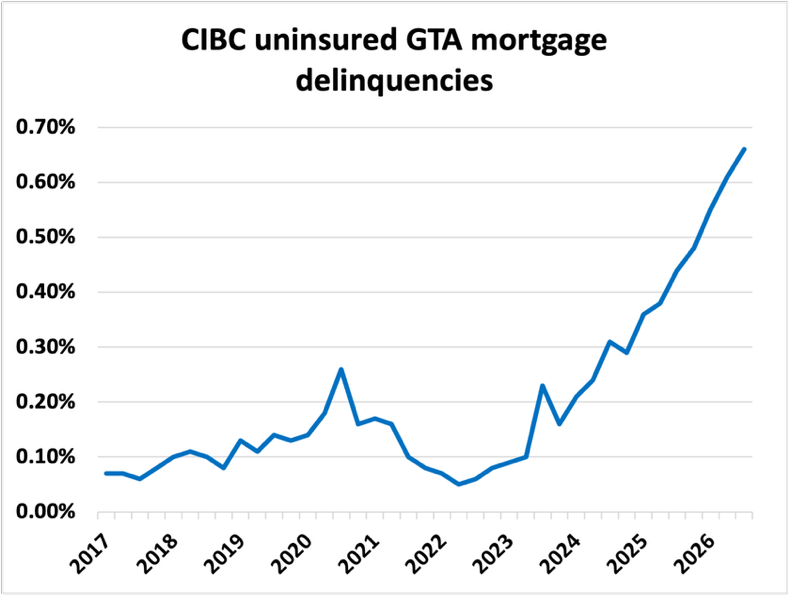
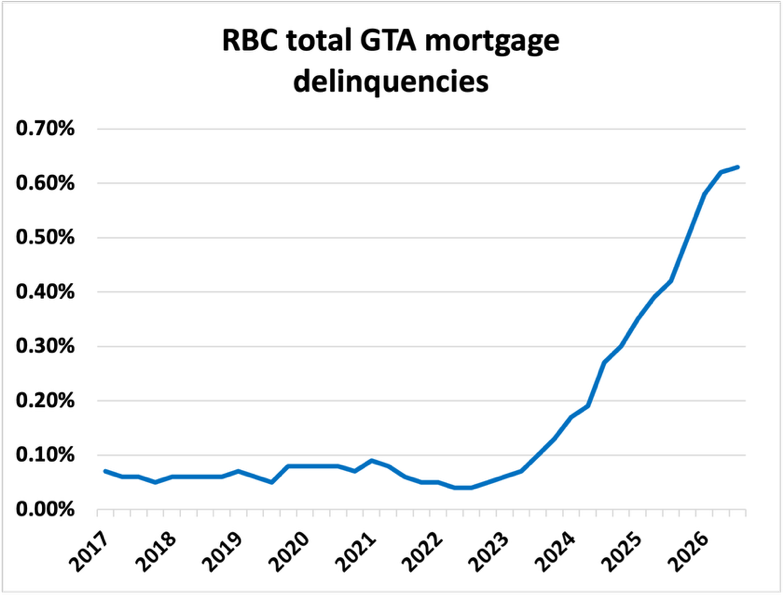
Those are still low delinquency rates in absolute terms. This is not a U.S.-2008-style mortgage apocalypse, and anyone telling you otherwise needs to spend less time on YouTube. But the direction matters. More importantly, the deterioration is occurring several years after the initial rate shock and after a substantial decline in mortgage rates. That tells us the problem is increasingly about accumulated borrower stress, weak resale liquidity and impaired household balance sheets — not simply the overnight rate.
The non-prime canary is coughing
Equitable Bank gave us another useful window into the Ontario credit cycle. Adjusted provisions for credit losses jumped 85% quarter-over-quarter and 147% year-over-year, reflecting higher provisions across several lending businesses. Gross impaired mortgage balances rose another 5.1% sequentially and 38.6% from a year ago.
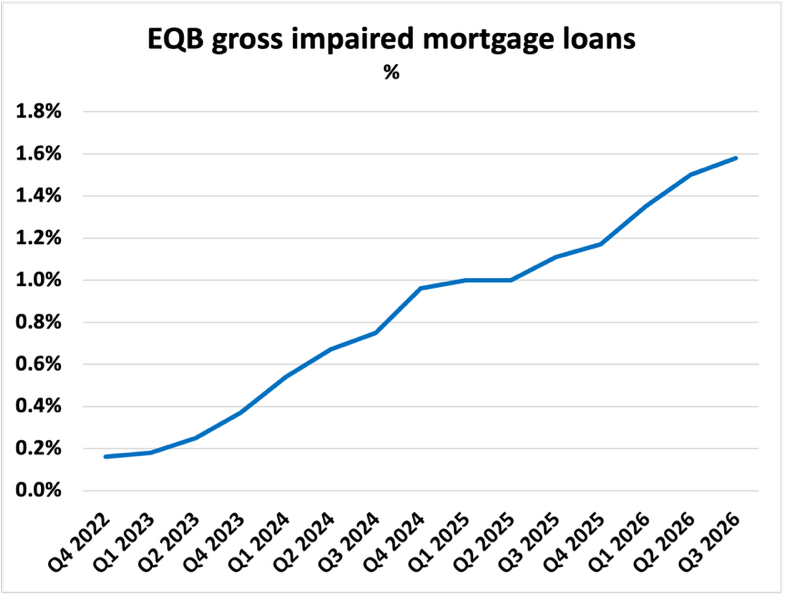
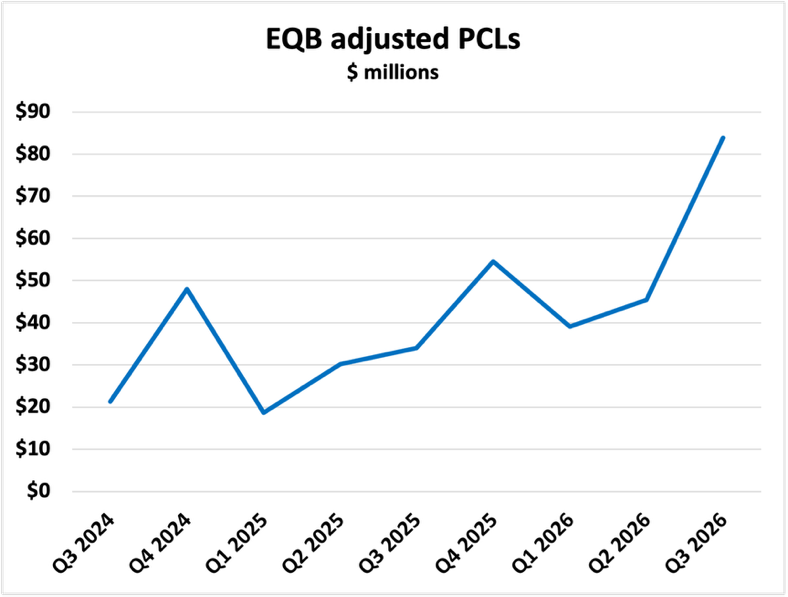
Management again pointed to credit stress concentrated in selected GTA suburbs. I will protect the identity of the municipality involved, except to say that it probably rhymes with “Crampton.”
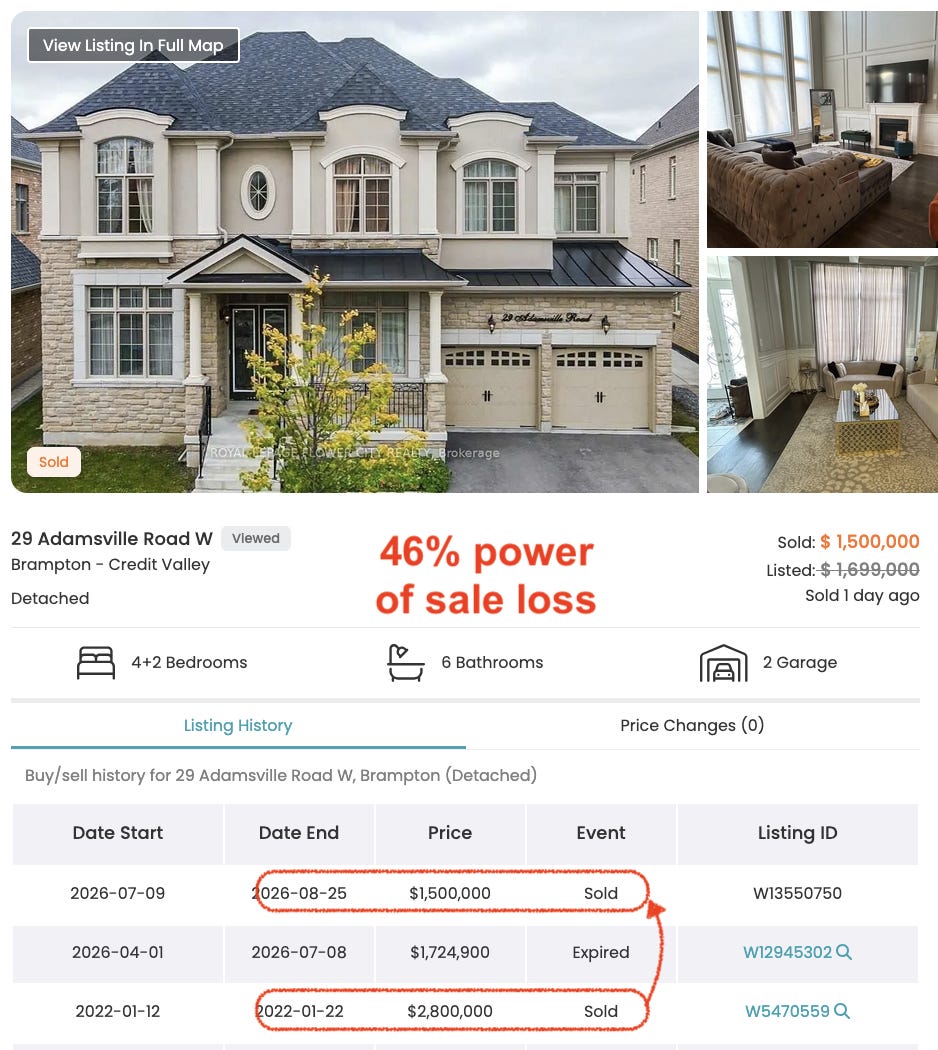
What we know is that power of sales are spiking in certain GTA suburbs (per the Globe and Mail), and the realized losses relative to the purchase price is rising. Consider the example below:
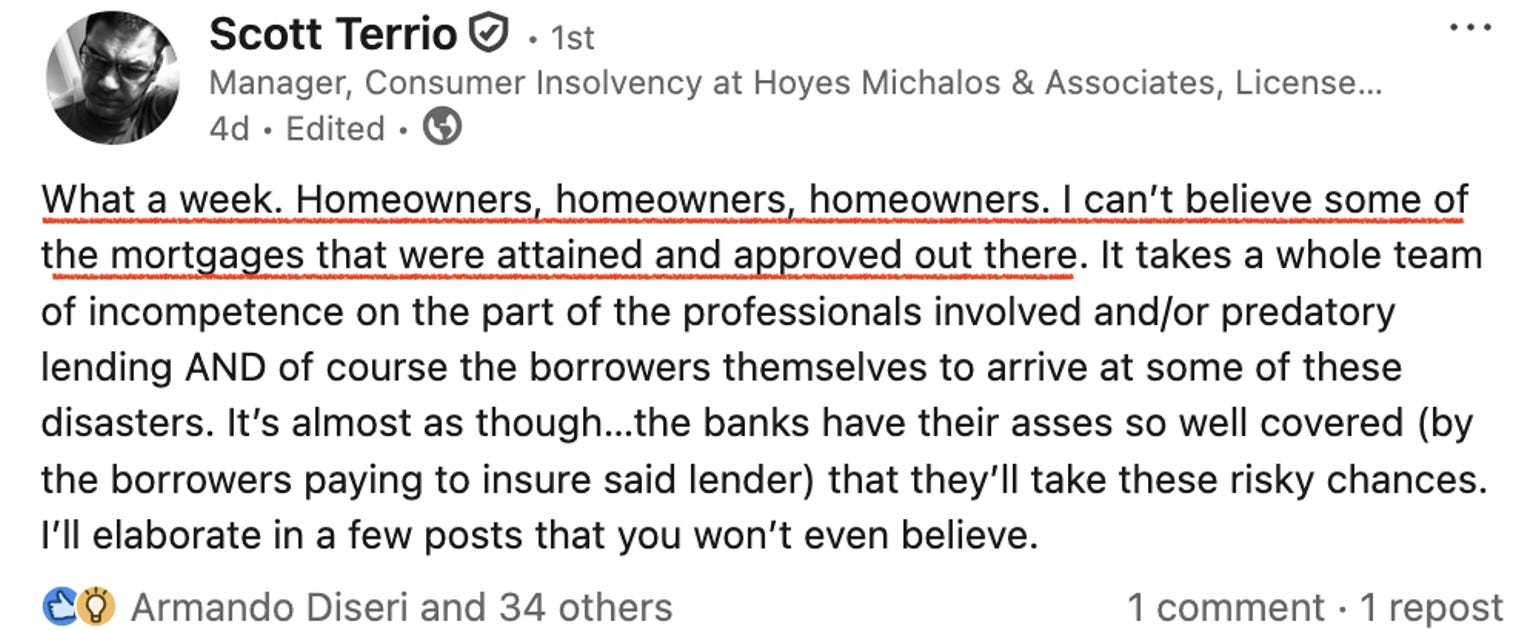
And this does not appear to be slowing yet. Ontario insolvency trustee Scott Terrio has been flagging a sharp increase in homeowner files and power-of-sale situations. His recent description of the volume was essentially the professional-insolvency version of: “Guys, you might want to come look at this.”

Ontario mortgage delinquencies are back at 2010 levels
The latest Canadian Bankers Association data add another piece to the story. Nationally, the mortgage delinquency rate actually edged slightly lower in June. Ontario went the other way: the number of delinquent mortgages reached roughly 7,000, the highest since 2010.
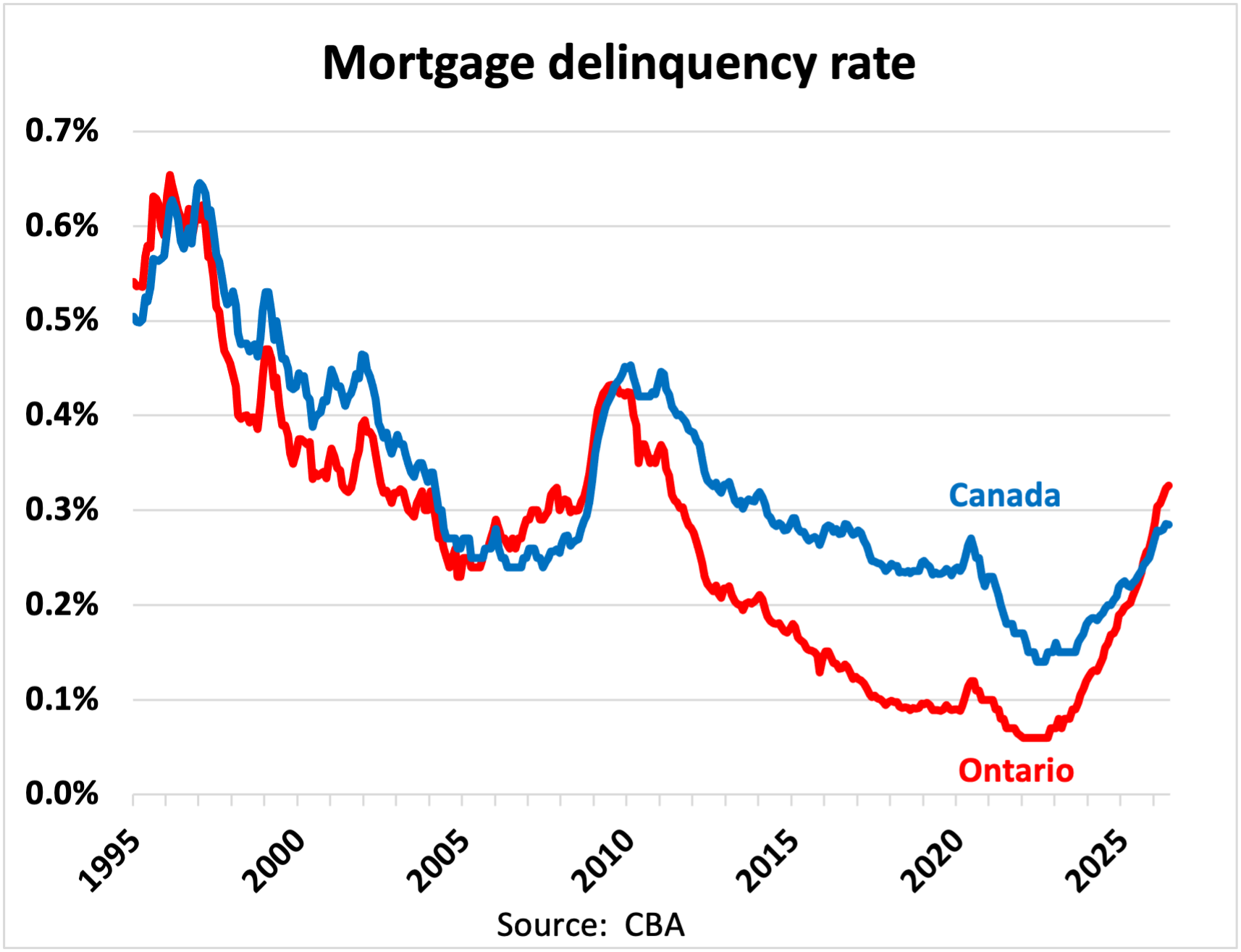
That is notable on its own, but there is an important wrinkle in the CBA data that is easy to miss. The CBA measures delinquency by the number of mortgage accounts, not by the dollar value of mortgages that are delinquent.
Normally that distinction is mostly academic. Right now, it matters a lot.
The headline delinquency rate may be understating the problem
Here is the simplest way to think about it. Imagine a mortgage portfolio with ten loans. Nine are $1 million each and one is a $9 million jumbo mortgage. Total portfolio: $18 million.
If the $9 million loan goes delinquent, the account-level delinquency rate is just 10% — one bad loan out of ten. But measured by outstanding balance, 50% of the portfolio is delinquent.
That is an exaggerated example, obviously, but it captures what appears to be happening at the margin today. CMHC and Equifax data show delinquency rates rising much faster among mortgages with larger original balances. In other words, the distressed cohort may still be relatively small by number of borrowers, but the loans going bad are increasingly chunky.
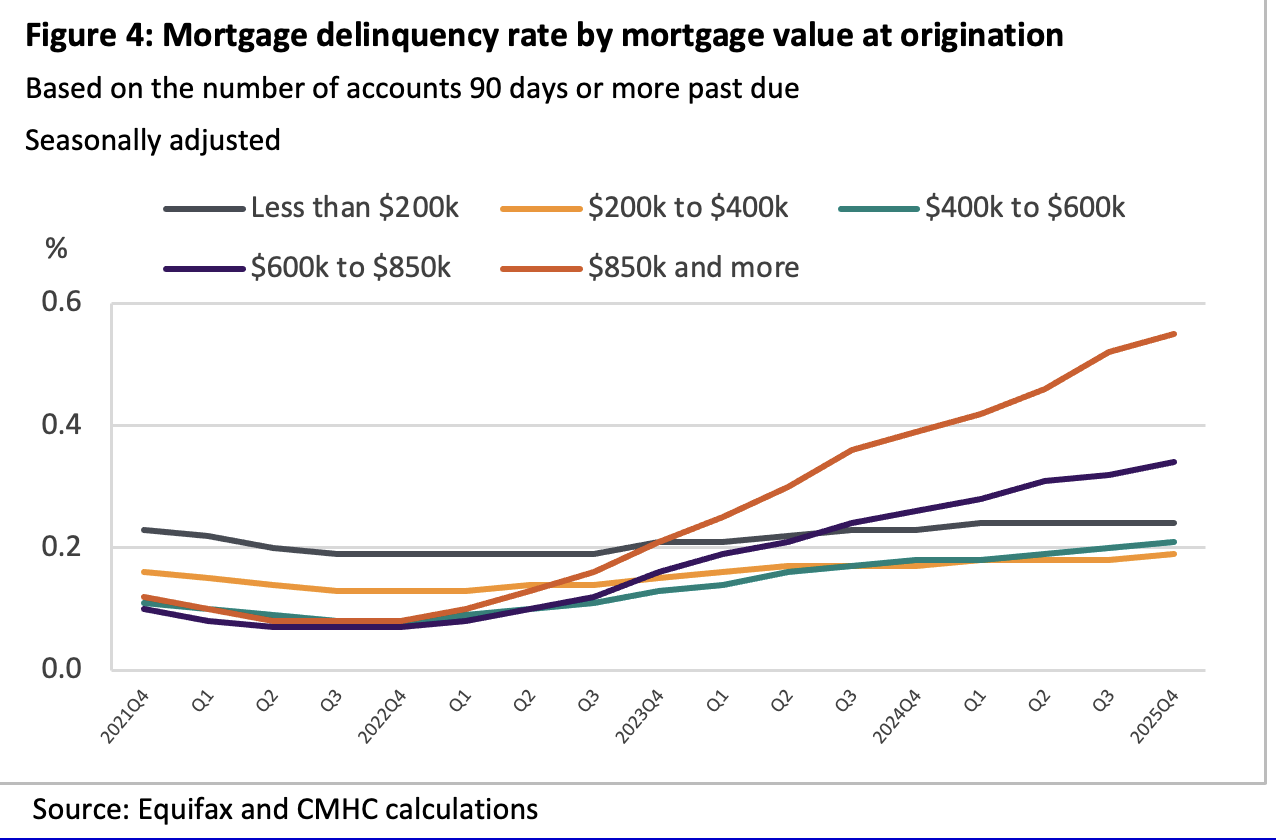
That helps reconcile something that otherwise looks contradictory: aggregate CBA delinquency rates remain fairly benign, while gross impaired mortgage balances at the banks are rising much faster. The answer is that the average problem loan appears to be getting more expensive.
This is also why I would be careful with the argument that “mortgage arrears are still low.” Technically true. Also not the whole story. If the borrowers falling behind owe substantially more money, cure rates are deteriorating and collateral values have fallen, lenders can experience rising losses without ever getting a spectacular headline delinquency number.
Bankruptcies are now sending a louder signal
The insolvency data are arguably even more concerning. Canadian bankruptcies were up 14% year-over-year in the latest month. That is distinct from consumer proposals, which restructure unsecured debt and allow many households to avoid bankruptcy.
The dollar value of liabilities tied to insolvency filings is rising much faster than the number of filings themselves — up 40.6% year-over-year nationally. Again, we see the same basic pattern: it is not just the number of stressed borrowers that matters; the size of the balance sheets blowing up matters too.
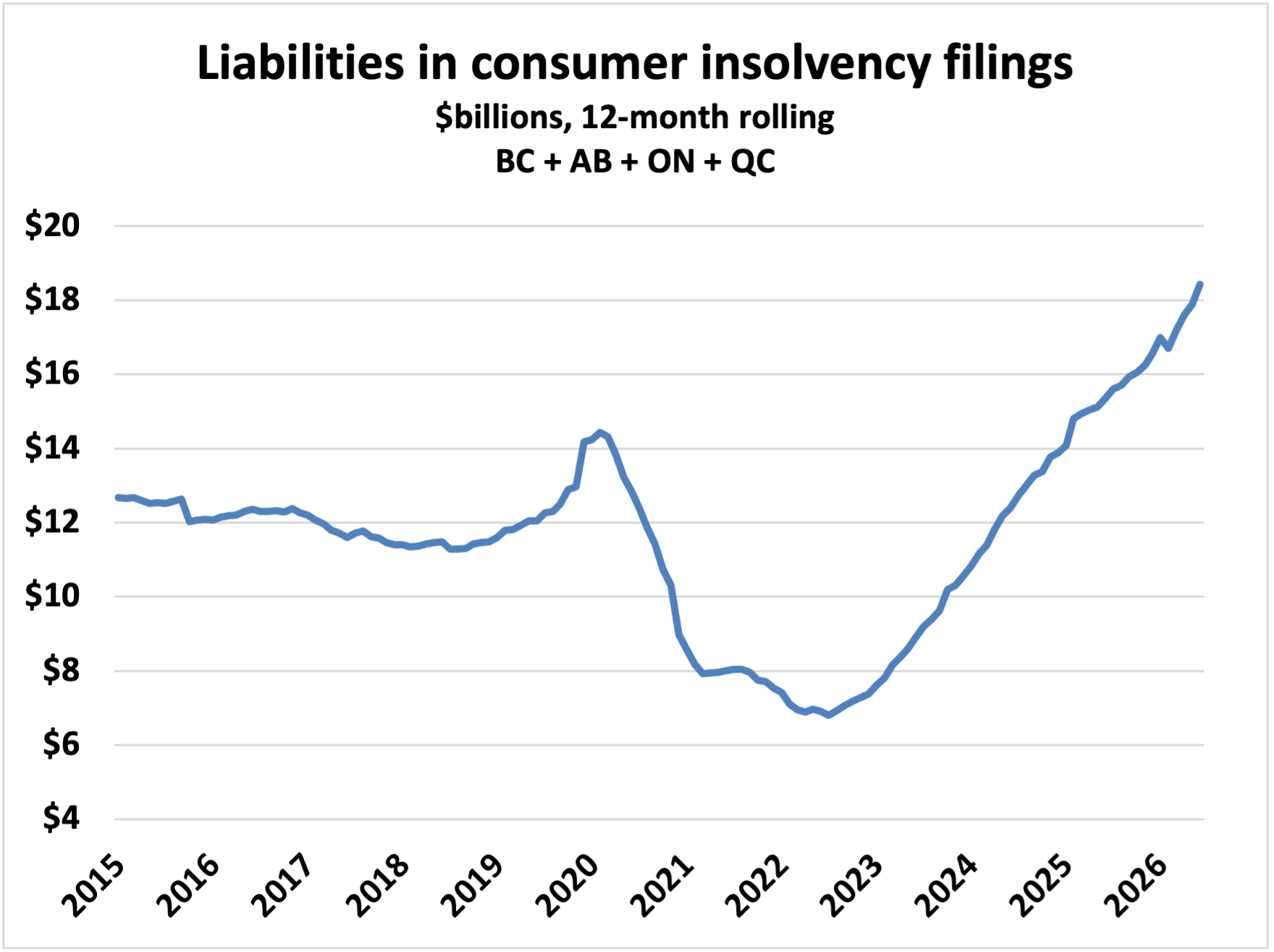
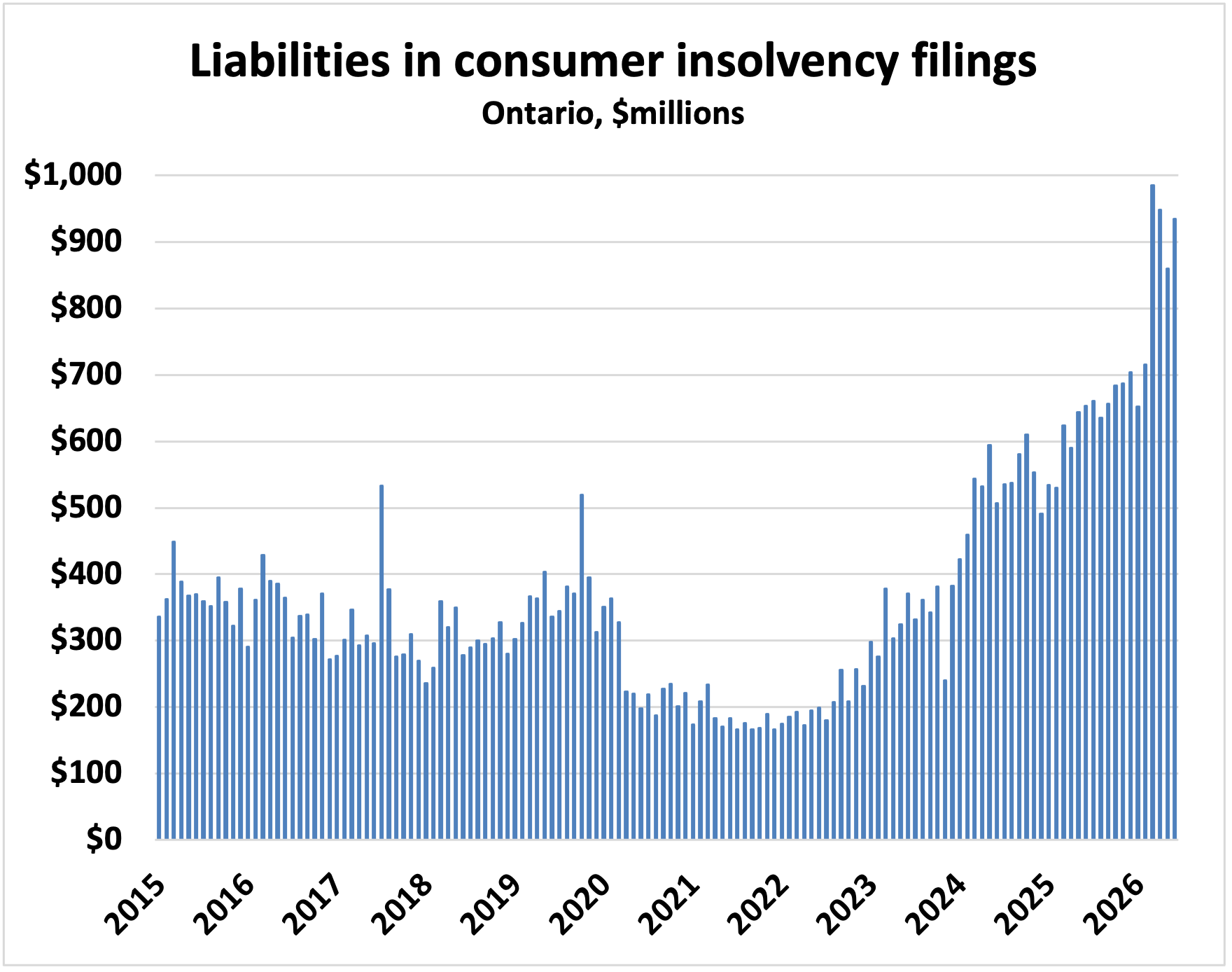
Ontario is driving much of the deterioration. Bankruptcy filings surged 25.5% year-over-year in June to the highest level since 2019. More strikingly, the dollar value of liabilities in Ontario insolvency filings has inflected sharply higher and recently posted the third-highest monthly tally on record.
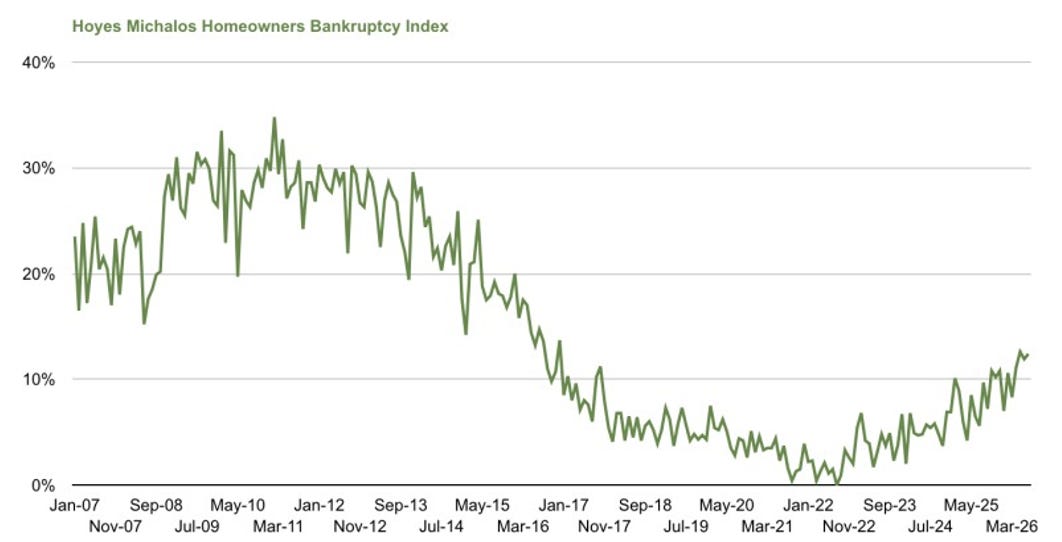
Hoyes Michalos’ internal data also show that the share of Ontario insolvency filings involving homeowners is rising. It remains well below the levels seen during the 2008–2013 period, which is important context, but the trend is unmistakably moving higher.
So what does this mean for Ontario housing?
None of this means Ontario home prices have to keep falling. Credit conditions are a lagging indicator, and housing markets can begin to stabilize before household credit metrics turn. In fact, that is often how a bottoming process works.
But it does mean we should be careful about confusing stabilization in sales or prices with a clean bill of health for the household sector. Ontario is still working through the financial consequences of the 2020–2022 housing boom, the subsequent rate shock and several years of weak affordability.
The most important takeaway is that the stress is becoming more concentrated rather than disappearing. A relatively small group of borrowers — disproportionately in parts of southern Ontario, with larger mortgage balances and often weaker credit profiles — is getting into deeper trouble. At the same time, bankruptcies and liability balances are rising, power-of-sale anecdotes are becoming more common, and lenders are still building reserves.
That is not a systemic crisis. It is, however, a very real credit deterioration — and one that is still moving in the wrong direction.
Ontario housing may be trying to find a floor. Ontario credit, for now, is still looking for the basement.
~Ben
For more from Ben, check out www.edgeanalytics.ca
I learned more from this than reading the Globe & Mail real estate section …. forever.
Ben - aren't there a bunch of risks here that could switch up your base case?
1. what happens if a sustained inflationary spike comes from oil shock hitting most supply chains, natural gas shock hitting fertilizer and food (all but guaranteed on this one now), helium from natural gas hitting AI chips? Will BoC avoid cuts or even hike - i doubt big hikes as it would sink a lot of mortgages and make your numbers worse but there seems to be hikes priced in now?
2. What if separately we don't hit fiscal responsibility here in Canada or across the US? Bond yields spike across the curve- maybe there will be some yield curve control in line but i wonder how much they can do given the size of market. If they're successful on the short end... then there's a massive boost to RE... if the market revolts though??
Seems to me like we will need to see how much governments can influence the bond and money markets.