


Stay up to date with Canadian data every month and download the (free) chartpack below.

Canada’s Public Sector is Shrinking Fast
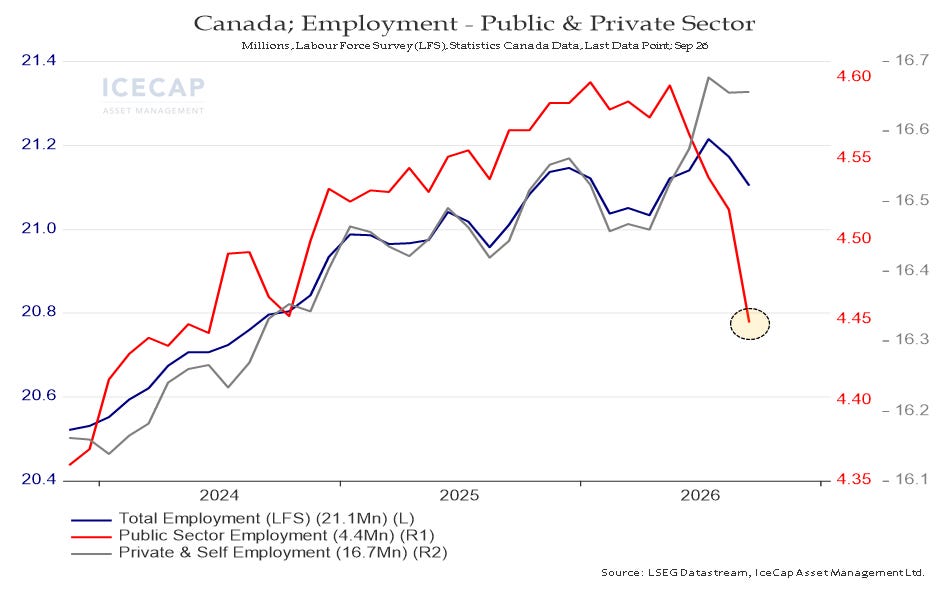
Canada lost 68k jobs in September. At first glance, that is not good. It means real families will face the grim uncertainty over their mortgages, bills, and maybe even their next meal. However, for Canada as a whole, it is part of a necessary recalibration. More than half of the decline came from the public sector, which shed 70k jobs.
For years, the public sector has contributed disproportionately to total employment growth. From Jan. 2019 to Dec. 2025, public sector employment growth accounted for 40% of job growth, lifting the public sector’s share to a 30-year high. It was completely unsustainable.
Of course, government employees are critical to any civilized society, as they deliver essential services the private sector often cannot or will not. But too many, and they can crowd out the private sector, reducing overall productivity and economic growth, and become a burden financed by taxes or debt.

In Canada, the massive increase in public sector employment also coincided with a fall in government services. Something was wrong. So the correction we’ve seen over the past few months is long overdue for an economy desperately in need of higher productivity growth.
Global Risk is Synchronized - Canada Beware
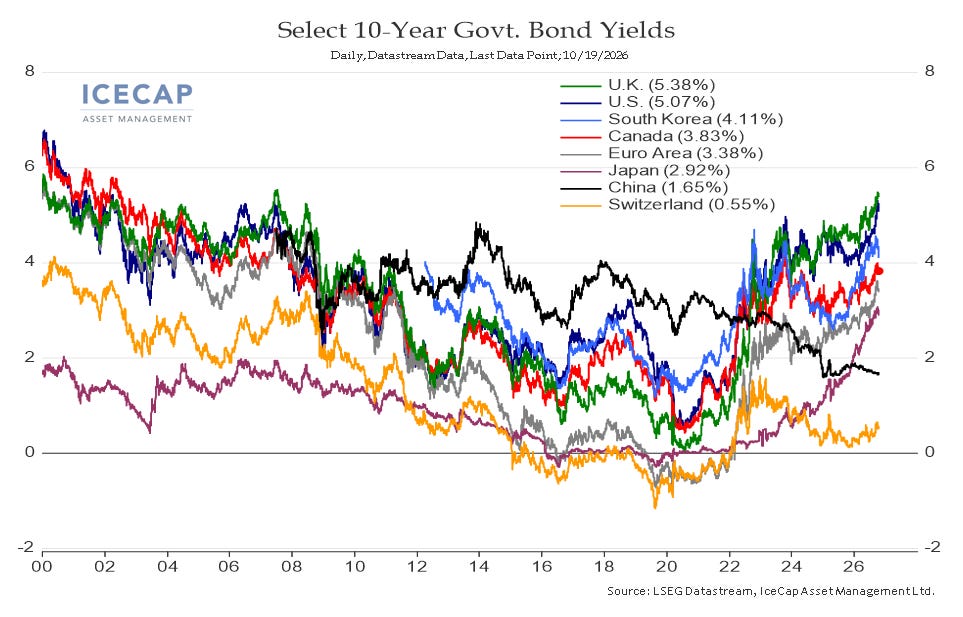
Canada faces the spectre of higher inflation and massive budget deficits, so owning bonds was always going to be risky. But global bond yields are climbing almost everywhere, and this rising tide is putting additional upward pressure on the government’s cost of borrowing.
As yields rise together across the world’s major bond markets, the risk of contagion grows—and so does the risk of something breaking in the credit markets. Canada, given its relatively strong fiscal position and oodles of crude oil and gold, will not be the epicentre of a global bond blow-up. But in a world of synchronized risk, that may not matter.
Generational Stagnation: Is it really over?
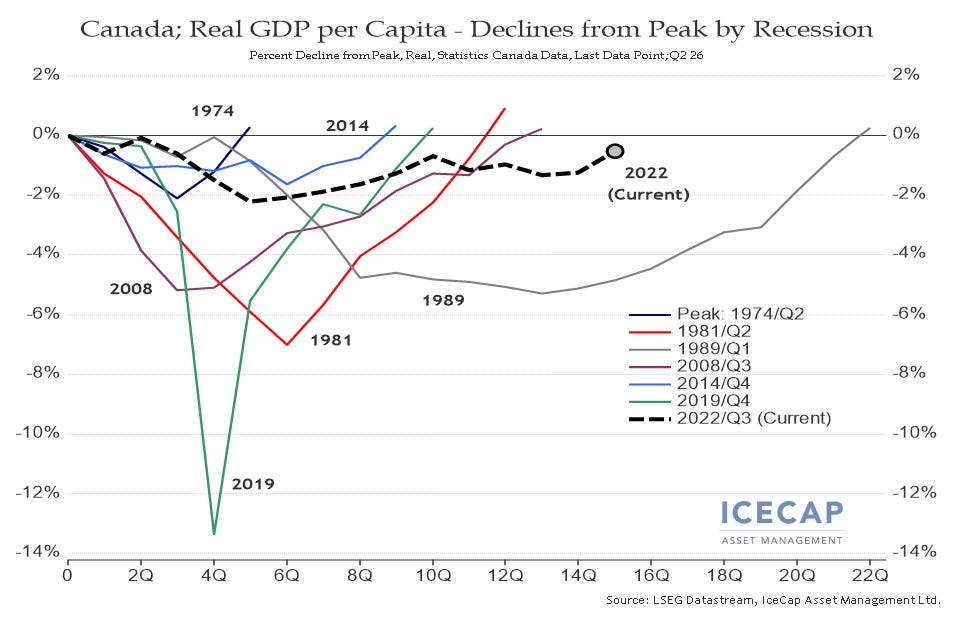
Since 2015, Canada’s real GDP per capita has barely budged. It is a lost decade. More recently, real GDP per capita peaked in Q3 2022 and has failed to pip this high-water mark for 15 quarters. That is a long time. Nearly a record. The winner of this dubious honour dates back to the late-80s cycle.
For a country as well endowed as Canada, this doesn’t happen without some effort. But the problems stem from more than a few years of childish, ineffectual policy. Many issues are structural. They have been well documented and ignored for decades. It finally came to a head, forcing the Bank of Canada to raise the flag in March 2024. They called it an emergency. Exceptionally strong words for a central bank. Yet, sadly, to no avail.

Now, however, a glimmer of hope is on the horizon. Ottawa’s tone is shifting, and governments from coast to coast are talking of shedding much of the Malthusian attitude and policies that got us here.
What changed? The boorish rhetoric of a man nearly every Canadian hates. He shan’t get any credit. But there is movement, and there is finally a consensus that something must be done.
But it’s cold comfort. None of the structural issues that got us here, a bloated public sector, chronic underinvestment, regulations, and high taxes, to name a few, have actually been addressed. We have yet to fix anything. We just got a tailwind from Oil. Nevertheless, that might be enough to push Canada over the line this year, and that’s something.
Take a look at the data yourself with our downloadable Chartpack below.